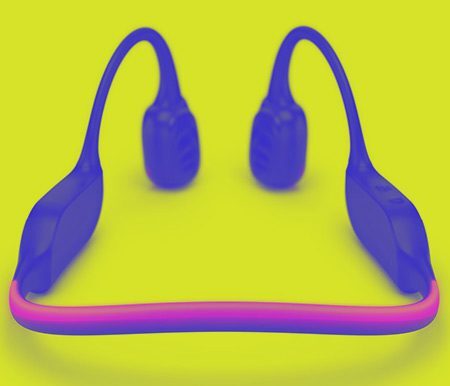


What are bone conduction headphones?
Headphones that transmit sound to the inner ear via vibrations rather than loudspeakers are known as bone conduction headphones. Bone conduction headphones therefore use the principle of bone conduction, in other words the sound is conducted to the inner ear via the cheekbones and the skull bone. Once there, they stimulate the fluid and the cilia of the earcup to vibrate.
Advantages of bone conduction headphones
The first aspect to mention here is safety: As the ears are not covered and therefore remain completely uncovered, you remain acoustically “connected” to your surroundings at all times, which greatly increases safety in road traffic or during sporting activities.
In addition, there is the wearing comfort: if over-ear or in-ear headphones cause you discomfort on or in your ears, you can avoid this thanks to the design of bone-sound headphones. These types of headphones usually consist of a soft neckband with small vibrating ‘boxes’ at the ends that sit roughly at your temples. There is no pressure discomfort or sweaty ears here!
Bone conduction headphones can also be suitable for certain hearing problems. As the sound bypasses the eardrum, people with certain types of hearing loss can benefit from this technology.
This type of sound transmission is ideal for use in and under water. The fact that no air is moved, but a so-called “transducer” vibrates and transmits the sound to the temporal bone, from where it ultimately reaches the auditory bone, means that no membranes are required.
Disadvantages of bone conduction headphones
The biggest drawback of bone conduction headphones is certainly their sound quality: Compared to headphones that work with conventional driver systems, bone conduction headphones cannot offer the same sound experience. Put simply, the full frequency range cannot be transmitted via vibrations. Important signal components are therefore missing, particularly in the bass and treble. In addition, the possible output volume is also quite low.
What is a great advantage can of course also be a serious disadvantage. Because if the ears remain uncovered so that ambient noise remains perceptible, this conversely means that loud environments have a strong impact on the playback quality and you may hear little or nothing of your music.
Fit and stability can also be a shortcoming. The fit can vary and not all models fit every head equally well. Only trial and error will help here.
Are bone-sound headphones healthy or harmful?
This is another question we are repeatedly asked by our readers. The fact is: there are no studies that indicate that bone-sound headphones are a direct health risk. Quite the opposite: as they transmit sound via bone conduction, they relieve the strain on your eardrum and ear canal. As mentioned above, bone conduction headphones may be suitable for certain people who struggle with hearing problems.